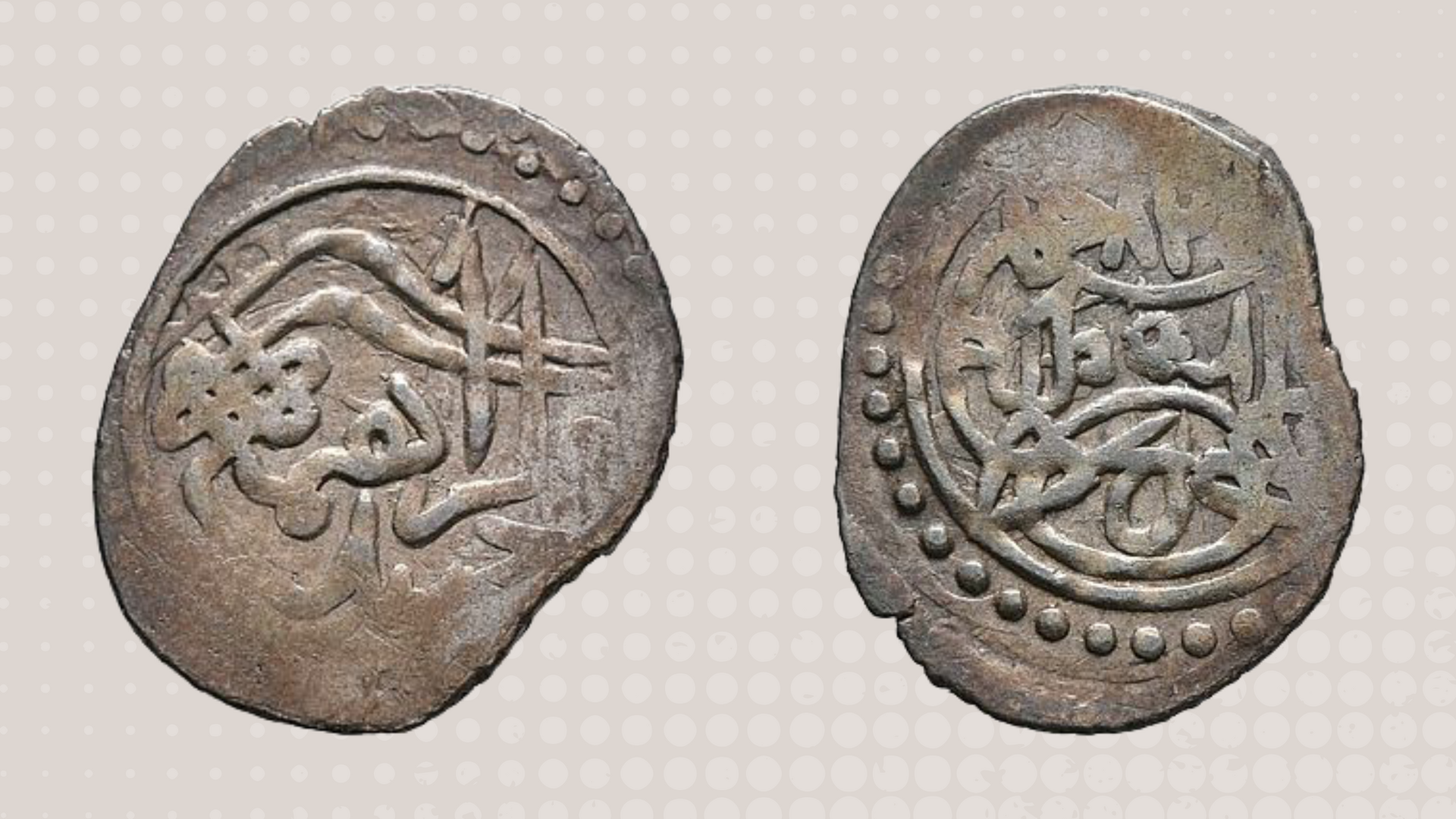

Alle drei Monate präsentiert die Forschungsstelle für islamische Numismatik Tübingen (FINT) ein besonderes Stück aus ihrer Sammlung.
The Aydınoğulları Beylik was eliminated exactly 600 years ago. Regarded as the final ruler of this principality, Junayd Beg stands out as one of the most controversial figures in Western Anatolian history. His identity has long been a subject of debate among historians. While some accept him as a legitimate member of the Aydinid dynasty, others have evaluated him merely as a local military leader and a usurper who emerged in Izmir. How can we ascertain the dynastic affiliation of a ruler who lived six centuries ago? Chronicles may contradict one another, and waqf (pious foundation) records may remain incomplete. Yet, occasionally, a tiny silver coin can offer an unexpectedly clear answer to a to a long-debated historical question.
The FINT coin for summer 2026 is an Aydinid akçe dated AH 825 (1422 CE), weighing 0.78 grams. At first glance, the type does not appear distinctly different from other contemporary beylik akçes. What renders it exceptional, however, is that it explicitly bears the patronymic alongside the ruler’s own name. Executed in the form of a tughra on the obverse, the inscription Junayd ibn Ibrāhīm (with the ibn connected to the last letter of Junayd in the bottom line) is not merely a standard indication of no further significance (in this case). Indeed, the dynastic affiliation of Junayd has long been a subject of contention in both contemporary sources and modern historiography.
Den ausführlichen Beitrag zur „Münze der Saison“ finden Sie auf der Webseite der FINT.
Die FINT wird gefördert von der Pelling-Zarnitz-Stiftung.